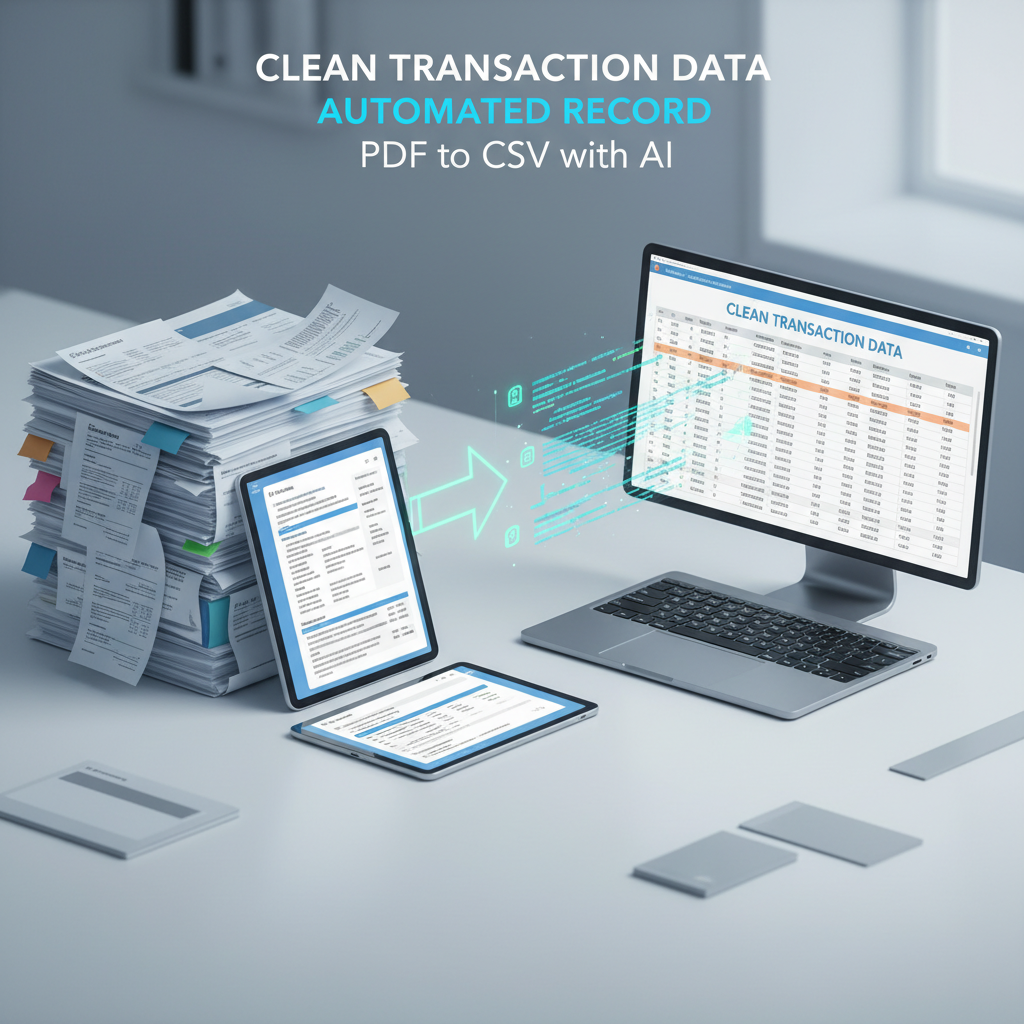
Stop Spending Hours Cleaning Bank Data: The Automated Way to Fix Messy Records
Messy bank exports waste hours every month. Here's how automated cleanup fixes formatting, duplicates, and mislabeled transactions — instantly, at 99.9% accuracy.
Streamline Your Books: The Definitive Guide to Automated Bank Record Cleanup
The Hidden Costs of Manual Bank Transaction Entry
For bookkeepers, accountants, and small business owners, the daily grind of processing bank statements manually is more than just tedious—it’s a silent drain on resources. This traditional approach is riddled with hidden costs, from the considerable time spent on data entry to the inherent risks of human error. These inefficiencies don't just slow down operations; they can have significant financial implications, impacting everything from cash flow analysis to tax preparation. Thankfully, the era of automated bank record cleanup is here, offering a powerful solution to these long-standing challenges.
Beyond Time: The Ripple Effect of Data Entry Errors
Manual data entry, regardless of how meticulous, is prone to mistakes. A single misplaced digit or overlooked transaction can initiate a costly ripple effect, leading to reconciliation headaches that consume even more precious time. These inaccuracies don't just impact your ledger; they can compromise compliance, distort financial reports, and ultimately lead to flawed business decisions. The true cost extends far beyond the time saved—it's about the integrity and reliability of your entire financial ecosystem.
The Challenge of Raw PDF Bank Statements
Raw PDF bank statements present a significant hurdle for efficient financial management. Their unformatted, diverse layouts make it incredibly challenging to extract usable, structured transaction data. Each bank, and sometimes even different statement types from the same bank, can have a unique design, rendering simple copy-pasting or basic data extraction tools ineffective. This complexity is precisely why bank statement data cleanup for bookkeeping has historically been such a labor-intensive task, demanding hours of manual effort to transform disparate PDFs into an organized, analyzable format. Learn more about navigating these challenges in our guide to eliminating manual bank statement data entry.
Methods for Bank Statement Data Cleanup: A Comparative Overview
Transforming raw bank statement data into a clean, structured format is critical for accurate financial management. Let's compare the most common approaches, weighing their pros, cons, and suitability for various accounting needs.
Manual Data Transcription: High Effort, High Risk
The traditional method of manually typing out each transaction from a bank statement is, regrettably, still in practice for some. This approach, while seemingly straightforward, is incredibly high-effort and high-risk. It’s slow, expensive, and alarmingly susceptible to human error, which, as we’ve discussed, can have far-reaching consequences. For businesses looking for how to reduce bookkeeping data entry from bank statements, manual transcription is rapidly becoming an obsolete and unsustainable practice.
Optical Character Recognition (OCR) for Bank Statements: Progress and Pitfalls
Basic Optical Character Recognition (OCR) technology marked a significant step forward from manual entry. It can convert images of text into machine-readable text, offering a faster alternative. However, for the intricate and varied layouts of bank statements, basic OCR often falls short. It struggles with different fonts, scanned documents, tables, and conditional data, frequently leading to misinterpretations and requiring substantial post-conversion cleanup. While an improvement, it still introduces a layer of manual correction that negates much of its intended efficiency.
AI-Powered PDF to CSV Conversion: Precision and Efficiency
This is where advanced AI extraction technology truly shines, offering superior capabilities for automated bank record cleanup. Services like Bank Statements CSV leverage sophisticated AI to accurately parse diverse PDF bank statement layouts, extracting transaction data with remarkable precision and delivering clean, structured CSV files. This method dramatically minimizes errors, accelerates processing times, and provides a reliable foundation for your financial records. Discover how AI can achieve 99.9% accuracy and unmatched efficiency.
The Role of AI in Handling Complex Statement Formats
Unlike basic OCR, AI-powered solutions don't just recognize characters; they understand context, patterns, and varying data structures across different banks and statement designs. This intelligent parsing allows AI to accurately identify dates, transaction descriptions, debits, and credits even from highly complex or unconventional layouts. It’s this deep contextual understanding that enables AI to overcome the limitations of traditional methods, providing truly reliable bank statement data cleanup for bookkeeping.
Implementing Automated Bank Record Cleanup: A Step-by-Step Guide
Integrating automated bank record cleanup into your financial workflows is simpler than you might think. Here’s a practical guide to get you started, ensuring a smooth transition to enhanced efficiency.
Preparing Your Bank Statements for Seamless Automation
To ensure the highest accuracy and efficiency, a little preparation goes a long way. Organize your PDF bank statements clearly, ensuring they are legible and complete. For multi-page statements, make sure they are compiled in a single PDF in the correct order. While AI is robust, providing clear, well-scanned documents helps guarantee optimal results. For tips on managing complex documents, explore how to avoid missing transactions in multi-page statements.
The Automated Conversion Process: From PDF to Clean CSV
Once your statements are ready, the conversion process is typically straightforward and fast. With Bank Statements CSV, you simply upload your PDF bank statements, and our AI system takes over. Within moments—often 30-60 seconds—the advanced AI extracts and formats all the transaction data. The result is a clean, organized CSV file ready for download, eliminating manual effort and vastly speeding up your bank statement processing for small business books.
Verifying and Integrating Your Clean Transaction Data
After conversion, take a moment to review the generated CSV data for accuracy. Our platform boasts 99.9% accuracy, but a quick check ensures everything aligns with your expectations. Once verified, the structured CSV file can be seamlessly imported into your preferred accounting software. This streamlined transaction export for month-end bookkeeping simplifies reconciliation, ensuring your financial records are always up-to-date and precise. Learn how to convert PDF to CSV without data loss.
Maximizing Efficiency: Automated Bank Record Cleanup for Specific Software & Roles
Automated bank record cleanup offers versatile benefits, particularly when tailored to popular accounting platforms and professional roles.
Tailored Bank Statement Processing for QuickBooks and Xero
For users of QuickBooks and Xero, integrating clean CSV data from automated conversion services transforms the reconciliation process. Instead of manual entry or wrestling with imperfect imports, you can directly upload highly accurate, structured CSV files. This precision significantly reduces reconciliation time, minimizes errors, and ensures your ledgers are perfectly aligned with your bank statements, making bank statement processing for small business books within these platforms truly efficient. Get your complete guide to bank statement CSV for QuickBooks reconciliation.
Empowering Bookkeepers and Accountants with Streamlined Data
Automated cleanup tools are game-changers for bookkeepers and accountants. By freeing them from the drudgery of manual data entry and correction, these professionals can reallocate their time to higher-value activities like financial analysis, strategic advisory, and client consultation. This shift not only increases productivity but also elevates their role, proving precisely why automate bank transaction entry is essential for modern financial professionals. Compare the benefits in AI vs Manual CSV Cleanup.
Improving Financial Analysis and Auditing with Accurate Data
Clean, structured bank data generated through automation is the bedrock of reliable financial reporting. It enhances the accuracy of budgeting, forecasting, and performance analysis, enabling more informed business decisions. For auditing purposes, having consistently accurate and easily verifiable transaction data simplifies the entire process, bolstering compliance and confidence in your financial statements. This level of data integrity is invaluable for any organization striving for robust financial health.